The Fragrance of Frangipani

Mumbai, November 2016.
The Indian government's sudden demonetization of ₹500 and ₹1,000 notes had thrown the country into uncertainty. Yet, in certain circles, money continued to flow. Art galleries were busy, collectors were emerging everywhere, and paintings were being treated as investments.
For Aman, however, it was just another month of balancing responsibilities.
At forty-five, he was everything society admired—a responsible husband, a dependable father, and a diligent bank employee. His life moved with mechanical precision, measured in EMIs, deadlines, school fees, insurance premiums, and monthly budgets. He fulfilled every obligation expected of him, yet somewhere along the way he had lost sight of himself.
One evening, while searching through a dusty loft for old documents, he discovered a small oil painting wrapped in yellowing newspaper.
It was a nude study he had copied from an art magazine borrowed from the British Council Library during his college days. His very first oil painting.
As he held it in his hands, memories surfaced like forgotten fragments of a dream.
Aman was not active on social media. In fact, he barely understood it. Yet something compelled him to photograph the painting and upload it online. With help from his teenage son, he created an Instagram account and posted the twenty-five-year-old artwork.
He had no followers.
His son added a few hashtags and shrugged.
The next morning Aman noticed a notification.
One new follower.
Her username was Healing Hands.
The profile picture was unfamiliar, but the name beneath it stopped him cold.
Manju.
His first love.
A message awaited him.
"Hi. How are you?"
A few seconds later another appeared.
"Is that your painting?" ❤️
Aman's fingers trembled.
"Teddy... is that really you?"
For several moments there was no reply.
Then a single heart emoji appeared.
"How are you?" he asked.
"Life moves on," she replied. "I settled in Dallas after completing medicine."
"And you?"
"Bank employee."
"Still painting?"
Aman responded with a crying emoji.
"No big dreams materialized. I think I'm a failure."
A few seconds later her reply arrived.
"Failure?"
"I still remember the portrait you painted in school—the old woman with deep wrinkles on her face."
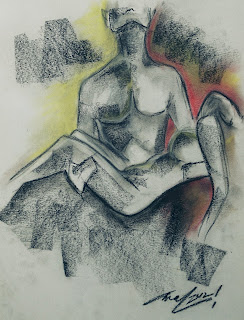
"And the nude figure sitting in meditation."
"You were creative far beyond your age, Aman."
"Don't stop painting."
"That's your soul."
That night he could not sleep.
The next day he pulled out an old cardboard box sealed with layers of duct tape.
Inside lay unfinished sketches, charcoal portraits, watercolors, competition certificates, and half-filled sketchbooks.
Each drawing transported him back to a forgotten version of himself.
He remembered winning district-level painting competitions organized by the Lions Club.
He remembered painting through entire nights without noticing the dawn.
He remembered believing that art was not a hobby but his destiny.
The discovery unsettled him.
His wife, Pragalya, practical and exhausted by life's demands, dismissed his renewed interest as a midlife distraction.
His son remained indifferent.
At work, colleagues laughed when they learned he had joined a weekend art club.
"Planning to become Picasso at this age?" one joked.
But Aman continued.
He painted before sunrise.
He painted after dinner.
He painted on Sundays.
As months passed, he met others carrying similar invisible wounds.
A classical dancer who had stopped performing after marriage.
A gifted singer who abandoned music while raising children.
A cricketer whose bat had not touched a ball in twenty years.
Together they realized a painful truth:
They were not failures.
They were flowers that had forgotten their fragrance.
The turning point came when Aman's aging school art teacher, Mr. Narayanan, visited a group exhibition displaying his work.
The old man stood silently before a painting of a frangipani flower pushing through cracks in a concrete wall.
After a long pause, he turned to Aman.
"Talent never dies," he said softly.
"It merely waits where we abandoned it."
The words lingered long after the exhibition ended.
Months later, Aman held his first solo exhibition at Jahangir Art Gallery in Mumbai.
The turnout was modest.
There were no newspaper reviews.
No television interviews.
No wealthy collectors fighting over his paintings.
Visitors came and went quietly.
Some paused before a canvas.
Some smiled.
Some simply stood and looked.
Yet as Aman watched them, he felt something he had not experienced in decades.
He felt alive.
On the fifth and final day, he wrapped the unsold paintings in bubble sheets and carried them home.
There was no disappointment.
Only peace.
When he entered the house, the familiar reality awaited him.
Loan statements.
Credit card bills.
School fee receipts.
Electricity bills.
Life had not changed.
The world had not suddenly recognized his talent.
The dining table remained exactly the same.
Aman smiled.
He placed the unsold paintings beneath his cot, beside dozens of newer works that nobody had seen yet—paintings he loved more than any he had exhibited.
Then he picked up a brush and stood before a blank canvas.
For the first time in many years, he could smell the fragrance of the frangipani.
And he understood that recognition was never the flower's purpose.
Its purpose was simply to bloom.

Comments
Post a Comment