Meera the Maya

Rhoviyan was an abstract artist with a unique name — a tribute to Rothko fused with “Viyan.” Lately he could not paint. Working in the same genre had become an exercise in boredom. He refused commissioned work; to him it felt like a brutal murder of his creativity. He found some solace in amateur poems and occasional art criticism for a small magazine that published cover stories on the city’s exhibitions.
Once there was an exhibition of realism by a well-known artist famous for female portraits. The paintings were hyper-real: a girl begging at a traffic signal, a sex worker sleeping half-naked from exhaustion, an acid-attack survivor, a gypsy with cat-eyed contact lenses. As Rhoviyan entered the gallery he saw people chatting, giggling, and arguing about art. Around fifty paintings hung in the grand hall: oils and acrylics. The aroma of hot cardamom tea drifted through the room; patrons wore polite smiles.
Something in the midst of the canvases caught Rhoviyan’s eye: a young woman in her twenties. She had a peculiar charm, features as if sculpted by a Renaissance master. He realized she wasn’t standing beside a painting. She was the painting.
The woman stood near a window where the setting sun poured into the gallery. Soft linen wrapped her body; a stole printed with colorful butterflies curved across her shoulders, and dozens of tiny mirrors sewn into the fabric scattered light around the room. The mirrors turned her into a moving constellation. A sea breeze from the open balcony made the stole flutter and the reflections dance like strobe lights on her face. For a moment she seemed less human and more goddess, with paint-like stars falling from her into the mortal world.
Rhoviyan felt a divine flabbergast. Not because she was beautiful — beauty had ceased to inspire him years ago — but because of something else: a loneliness, a sadness, an untold story. She stood before every painting as if listening to voices hidden beneath each stroke. Then she dissolved into the crowd.
When Rhoviyan reached the balcony she was gone. No name. No social smile. No eye contact. No gesture. Nothing. Yet that night, after two long years, his hands moved irresistibly. The abstract artist painted realism — a portrait of the woman engraved in his mind. For the first time in two years the canvas consumed him: the butterflies, the mirrors, the wind, the distant melancholy in her eyes. He worked without sleeping or eating. Three days later, when he finally stepped back, he saw what he had created.
The woman stood upon a shore of stars. Butterflies emerged from her stole and transformed into galaxies. The mirrors reflected fragments of forgotten worlds. She was divine and heartbreakingly human. He titled it “The Goddess of Lost Things.”
The painting became a sensation. Critics called it his masterpiece. Collectors made offers. Magazines printed it on their covers and newspapers ran long pieces in the art column. Yet Rhoviyan cared about only one thing: finding the woman.
Months passed. No one knew her. Gallery staff and CCTV footage showed no trace. The guest register contained hundreds of names but no lead. It was as though she had never existed.
Then a visitor asked a peculiar question at the exhibition. “Why did you paint the clock tower?”
Rhoviyan frowned. “There is no clock tower.”
The visitor pointed at one mirror on the stole. Within its reflection was a tiny clock tower. He had never painted it — at least not intentionally. The clock read 5:17. Curiosity turned into obsession. The tower bore the engraving P R and Sons and matched one near an abandoned railway station on the outskirts of Chennai.
Rhoviyan went to the station. Near it an old tea stall hung a faded sepia photograph. He held his breath. The woman stood beside the station master and the tea vendor in a casual snapshot. The photograph was twenty years old. Impossible: she looked the same age.
When he asked about her, the tea vendor’s face changed. “Are you talking about Meera?” he asked.
“You knew her?” Rhoviyan said. “Where is she?”
The old man fell silent, then answered in a flat voice. “Dead. No more.” He told Rhoviyan how Meera had been an aspiring dancer who traveled through the station, admired by many. Then one monsoon morning someone saw her brutally killed and thrown on the tracks of the railway station. The murder was gruesome; people said a rusted iron rod had been inserted into her private parts and penetrated deep into her abdomen, tearing her uterus; no one knew what happened to her. The police were not able to find who committed the crime. The crime was savage; the police never solved it. She was twenty-three when she died. The tea vendor pointed to the photograph. “She was wearing that butterfly stole the day she died,” he said.
Rhoviyan felt a chill. The woman he had seen at the gallery could not have been older than thirty; yet the photograph placed her presence two decades earlier, or she should have been dead.
That night he returned to his painting and studied every mirror in the stole. In each reflection he found hidden places: a dilapidated door numbered 12/31, torn political posters, fragments of neighborhoods. The painting had become a map. Guided by intuition, he tracked the clues to a slum near the station and to an old house.
He met her father, who was fragile and losing his memory. He had no energy for the old emotions; age had eroded his feelings of Meera.
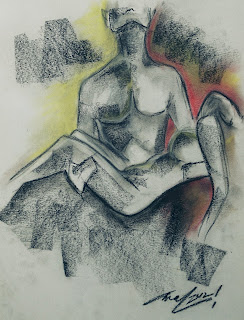
Inside the house was a wooden trunk half eaten by termites. Even the insects seemed cautious; hundreds of charcoal and graphite sketches lay preserved in a black-bound sketchbook. Portraits, surreal scenes, cubist scribbles — page after page. The first page carried a line written in elegant calligraphy: “Without monsters and gods, art cannot enact a drama.” A letter followed, addressed to no one, containing a single sentence: “Art is the only way we remain alive after the world forgets our names.” Signed, Meera.
Months later Rhoviyan organized a new exhibition of Meera’s works. He titled it “Meera the Maya.” It was dedicated to a forgotten dancer, a vanished woman, a witness to a brutal society — a muse who had resurrected an artist.
Visitors crowded the gallery. Many paused; some admired the strokes and technique. Rhoviyan noticed a new detail hidden among Meera's works — a sketch of himself standing in the gallery on the day they first met. A sketch dated twenty years before he was born.
Rhoviyan again saw her in the reflection of glass on one frame; she stood quietly, watching the painting and smiling. He turned to look for her. She was never there.
Would you like the tone tightened further, or should I make it more lyrical or more restrained?

Comments
Post a Comment